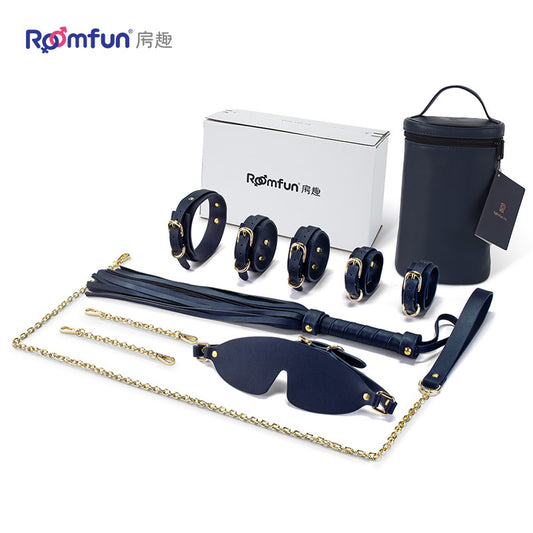
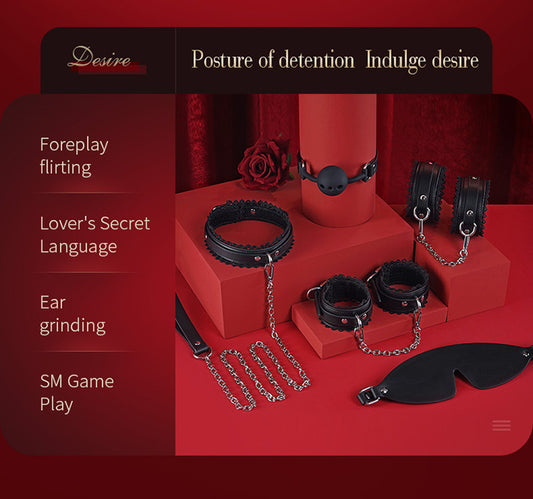
A Lead Is More Than a Matching Accessory
The visual line between a handle and an attachment point is part of a leash’s appeal. But when comparing bondage leashes and leads, the useful question is not simply which one matches a collar. It is what you are buying: a complete handled lead, a connecting chain, or a collar-and-leash set. Start there, then compare the details that distinguish one design from another.
Read the Design From Handle to Clip
At the hand: loop size, width and finish
Look for the handle’s own measurements, not just the strap width. Check whether its inner surface is lined, where seams or rivets sit, and whether the loop is fixed or adjustable. A decorative wrist loop should not be mistaken for a restraint cuff. For wrist and ankle accessories, compare purpose-specific bondage cuffs separately.
Along the lead: strap, chain or mixed construction
For a leather leash, check whether the specification describes the whole lead or only its handle. For a chain lead, distinguish link dimensions and chain length from the size of the end fittings. For a nylon design, examine the stated webbing width, edge finish and stitching. These are material comparisons rather than a promise that every construction is currently available in this category. Follow the cleaning instructions for each component, especially when a design combines materials.
At the end: opening, closure and intended connection
A photograph can show a clasp’s shape without showing its usable opening. Compare connector dimensions and how it opens and closes, then check the intended use of both pieces. A clip fitting through a ring does not prove compatibility or a load capacity. Do not attach a lead to a mouth gag, and do not improvise with decorative jewelry findings.
Choose Length for the Space, Not the Label
Short and long are relative descriptions. Compare the actual overall measurement and ask whether it includes the handle and hardware. Think about where loose length will rest: it should not trail across a walkway, loop around a limb or catch on furniture. A shorter lead is not permission to hold someone in position by the neck, and a longer one is not a reason to allow pulling or sudden changes in direction.
One Separate Lead or a Collar-and-Leash Set?
Buying separately lets you assess the lead without replacing another accessory, but it requires checking both manufacturers’ instructions and connection details. A set puts the pieces in one listing, yet matching appearance still does not establish what forces they can withstand. Read the included-parts list: a collar pictured beside a lead may be sold separately, and a chain pictured in a larger kit may not be a complete handled leash.
If you also need a wearable piece, start with the measurements and closures in BDSM collars. Keep its fit and removal requirements separate from the lead’s specifications. A front D-ring alone is not evidence that a collar is suitable for traction.
Agree on the Meaning. Do Not Use Neck Force.
A BDSM leash can be a negotiated visual or symbolic part of adult role play; it does not need pulling force to carry that meaning. Never use it to compress the neck, pull on the throat, jerk or drag someone, support body weight, suspend a person or tether them unattended. Do not attach it to moving objects. Remove equipment immediately for distress, dizziness, pain or difficulty breathing or swallowing.
Agree on what the accessory means and what will not happen before connecting it. Our guide to discussing boundaries, limits and consent supports that conversation. Choose recognizable safewords and nonverbal stop signals and keep removal accessible; neither a symbolic role nor a prior agreement replaces ongoing consent.
Details Worth Clarifying Before You Buy
Is the advertised length end-to-end?
Check whether the measurement covers only the strap or chain, or includes the handle and clasp. If the listing does not distinguish them, request the full measurement rather than estimating from a model photograph.
Does “lead” mean something different from “leash”?
The names are often used for similar accessories. Let the construction and intended-use instructions, not the label, determine your comparison.
Does heavier hardware mean a better choice?
Not by itself. Weight and a substantial appearance are not evidence of testing or a rated capacity. Prioritize clear specifications, suitable intended use and accessible removal over claims such as heavy-duty.
Looking for a different type of connection or restraint? Explore bondage gear and restraints, or compare other accessory categories within BDSM toys and gear. Choose each item for its own stated purpose, not simply to complete a matching look.